Hello you wonderful people. Guess what I'm doing next week. EFY!!!! I'm so excited. I get to spend a week at a campus that looks like a castle (UPS). :) Seriously fun stuff. EFY is the best. I could not say enough good things about it. On another note.....Actually I don't have another note. EFY!!! That's pretty much all I can think about right now. YAY!!!
Sagerific
Friday, June 27, 2014

Tuesday, June 3, 2014
Comedy of Errors Wordle!
Wordles are awesome. I don't know why I'm so obsessed with them, but they're so cool! Here's one made from the text of Shakespeare's 'A Comedy of Errors':

Coolness, right?! Haha I love it.
Sagerific
P.S.
If you want to make your own wordle, go to wordle.net and check it out.
Sunday, May 25, 2014
General Update :)
Hey guys! Been a little while since I posted. Let's see, what's happened since then?
I turned 16. - Yay! I'm 16! I don't feel any older. Maybe slightly more responsible. But not really. I had a good birthday, and an even better birthday party. Yay for friends! :)
Our ward boundaries were redesigned. - They switched a bunch of things up in a few wards. Three, to be precise. They took a bunch of people from our ward, put them with Centralia ward, took some people from Rochester ward, put them with our ward, and then moved our ward out of the Centralia building and into the Rochester building. Change is weird. And different. And I don't know how I like this yet, but I think it will be alright.
Other than that, not much else has happened. Oh yeah, Spencer turned 5! He's such a cute little stinker. Unfortunately, he knows it. And uses it to his best advantage. But he's awesome, and makes me laugh daily.
So....yeah. That's what's up!
Sagerific.
Friday, May 9, 2014
My personal tribute to Beethoven
So this last week has been a little rough, so far. My research project was due on Wednesday, and I was stressing out. STRESSING OUT. I don't honestly know if I did my best. I certainly gave it a good shot, though. The subject of my research project was Musical Composers of the Romantic Period. My choice. I picked it. I wanted to learn about and show how things in the lives of the composers influenced and/or affected their music. I learned a TON about several composers, but the one I really connected with was Beethoven.

Whenever I used to think about Beethoven, it was always like, "Yeah, that guy who was deaf and a little crazy and wrote Ode to Joy. Cool beans." But as I read about him more and more, I began to understand him. Here's a passage from a book, Lives of the Musicians: Good Times, Bad Times, and What the Neighbors Thought:
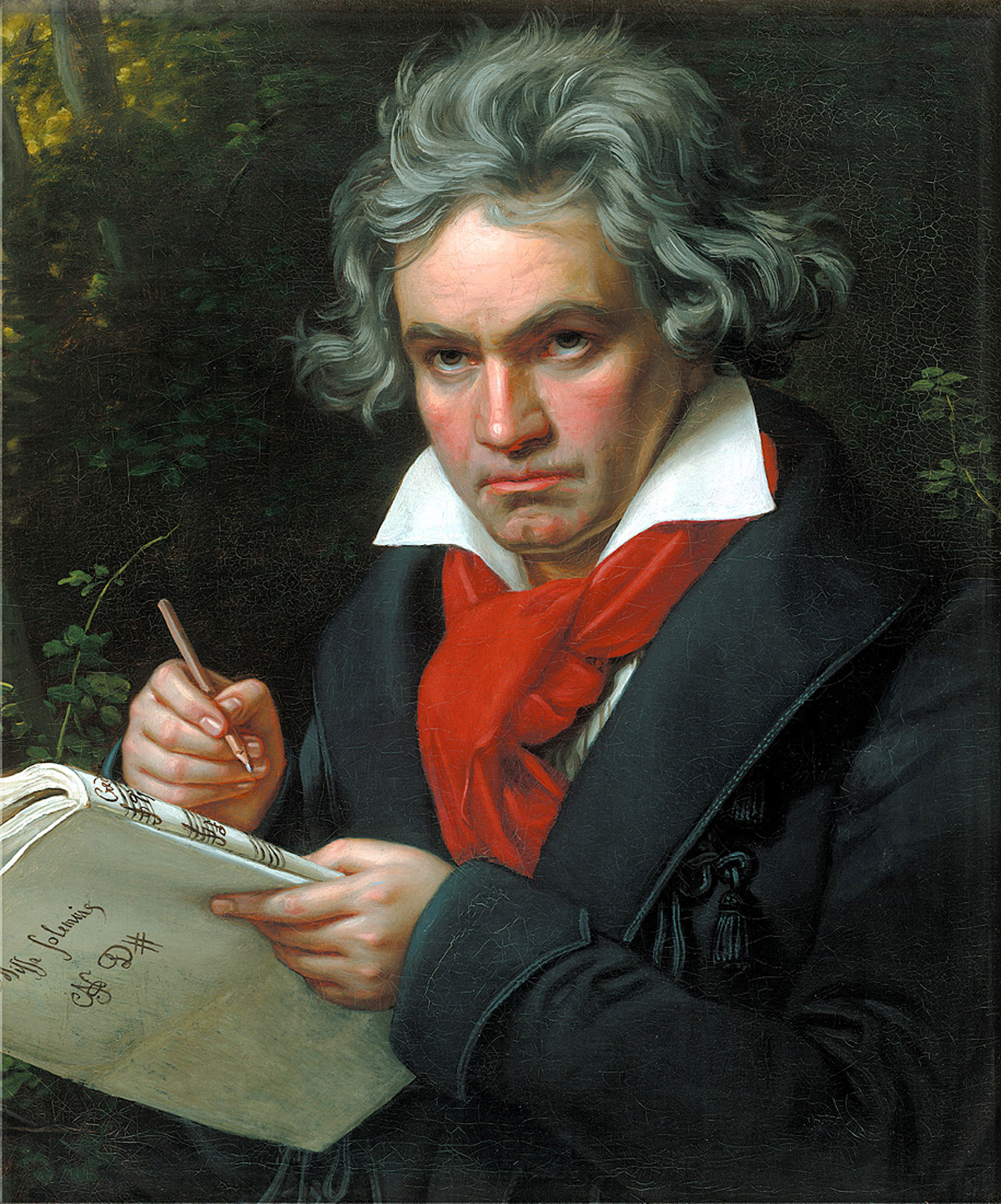
Whenever I used to think about Beethoven, it was always like, "Yeah, that guy who was deaf and a little crazy and wrote Ode to Joy. Cool beans." But as I read about him more and more, I began to understand him. Here's a passage from a book, Lives of the Musicians: Good Times, Bad Times, and What the Neighbors Thought:
The saddest thing about Beethoven's life was his gradual deafness, beginning in his late twenties. But he was used to writing music he couldn't hear. As a child he had been too young to play the compositions he wrote. As his hearing grew worse and worse, he lived inside his head more than ever and kept on writing music with no loss of energy. He broke strings on his piano trying to pound loud enough so that he could hear the notes. Frustration made him more moody, even at times suicidal.
I'd read that passage several times during the course of researching for my paper, but as I was actually writing the paper, it hit me a lot harder than normal.
Music is my life. It's my passion. It calms me. When I'm stressed out or I can't think straight, I go play Bach's Inventions, and the repetitive notes and complex fingering gives me something to focus on so I can think. When I'm sad or emotional I might play Chopin's Nocturnes. Sometimes when I feel happy or kind of silly, I play Princess and the Frog music and Sydney and I sing 'Almost There' at the top of our lungs. I am connected to music. Imagine how much more connected Beethoven was.
Beethoven did not have an easy life. His dad was an alcoholic who humiliated himself at court and was very abusive to Beethoven. When Beethoven was older, he fell out with many of his friends, including the prince himself, whom he felt treated him like nothing but an accessory to his wealth and societal stature. He also was rejected by every woman he loved. The only thing that never failed him was his music. But of course he lost his hearing in his twenties, and then even his music was gone. He said, "Music is like a dream I cannot hear." So when I read that part about him playing the piano, and pounding so hard that the strings broke, I guess I finally understood. Beethoven wasn't just a great musical talent. He was broken, but he was amazing. And he managed to endure the devastation of losing his hearing, his connection, his ability to experience music fully. In my opinion, that's what makes him so great.
Sagerific
Sagerific
Tuesday, April 29, 2014
Time for a new post...
I decided I need a new post. But I have writer's block. FOR MY BLOG. How did that happen? Do you guys know how many times I have started a post and not finished it, or closed it to come back later, but of course had lost my previous train of thought, or just opened my blog to feel guilty and irritated that I couldn't think of anything to write about? It is really frustrating. Besides, this blog is supposed to be comforting and make me happy and stuff. 'TIS NO SUCH THING. Well, sometimes it is. But not right now.
Look at that, I wrote enough to publish a short post!
Haha
Sagerific
Friday, April 4, 2014
Stuff I have planned/Check-in
Hello people. How are you? I am fantastic, and super excited and worried about the week ahead. This weekend I'm going over to my grandma's house to watch General Conference. For you non-Mormon people who read my blog (if any), if you want to know what General Conference is, look here. Also possibly included in this weekend is a trip to the theater to watch Captain America: Winter Soldier (crossing my fingers). But only possibly, and maybe/probably not. The coming week will be filled with biology, Spanish, book-reading, and essay-writing. Also project-researching, but mostly biology and Spanish. Then (hopefully) I'm free from my online classes!! Well, at least from biology. Man, that course sucks. Next weekend will be super busy. I have a youth temple trip, a play (working on, not going to), and who knows what else. Guys, it's APRIL. Where did the time go?! I have so much to get done!!
Anyway, hope you didn't get bored with my check-in. Bye!!
Sagerific
Tuesday, April 1, 2014
The Wisdom of Florence Nightingale (aka Sage is using her blog to write an essay again)
I’ve told several people about Florence Nightingale recently, and not very many seem to know who she was, or what she did. I, personally, have always looked up to Florence Nightingale. When I was younger, I read about her and decided I wanted to dress up as the famous nurse for Halloween (That’s right, people, I’ve been a nerd my whole life). So, in an attempt to educate you people who don’t know the awesomeness of Florence Nightingale, I have written a blog post. Yeah, I’m really into biographies, lately. Oh, and this is also an essay/assignment for class. Again. Here you go:
Florence Nightingale lived in England during the 1800s. During her lifetime, she improved military hospitals, started nursing schools, advocated women’s roles in society, and revolutionized the public health system. She was born into a family of high social standing. Because of her family’s social standing, she had to attend endless parties, gatherings, afternoon tea, or gossip sessions with other women of high class society. Florence was tired of the tedious social life she was expected to carry on, and yearned for independence. (Florence Nightingale.)
When Florence was 16, she received a call from God to devote her life to service. She wondered how she could do this, and decided that nursing would fulfill her calling. She fought her family on the subject for many years. Finally, her parents consented, on the condition that she seek an education in nursing privately, so as not to embarrass her family.
Florence enrolled at the Institution of Protestant Deaconesses in Kaiserswerth, Germany, receiving training for two weeks in 1850, and then again in 1851, for three months. She learned basic skills in nursing, patient observation, and hospital organization. In 1853, she wanted to break from her family’s social environment. Because of her and her family’s social connections, Florence was able to become the superintendent of the Institution for Sick Gentlewomen in Distressed Circumstances, in London. She displayed her great skill as an administrator by improving the nursing care, hospital efficiency, and working conditions. After one year, Florence decided that training nurses would be more beneficial to the public health systems. However, she did much more than just that.
In 1853, the Crimean War broke out between Turkey and Russia, with France and Britain joining in on Turkey’s side. Sidney Herbert, the Secretary of State at the time, wrote to Florence and asked her to bring a group of nurses to Scutari. In October 1854, Florence led 38 nurses to Scutari, only to be rejected by the medical officers there. The conditions at the military hospital in Scutari were absolutely repulsing. There were not enough supplies, the rooms and beds were rank and filthy, and the soldiers were dropping like flies. Five days after the arrival of Florence and her nurses however, the injured soldiers from the Battle of Balaklava and the Battle of Inkerman came and overwhelmed the hospital and the medical officers. Florence and her nurses were enlisted to help.
The hospital obviously needed improving. Florence saw to it that the beds were cleaned, supplies bought, patients washed and clothed and given adequate food. She worked in Scutari for long periods of time, and eventually collapsed from the work she pushed herself to accomplish. Later, she also contracted the “Crimean Fever” and had to take to her bed for much of her later years. (Selanders, Louise.)
Even after all she did in Scutari, she didn’t stop working for the improvement of the public health systems. She gained an audience with the Queen of England, asking to start a commision for sanitary military hospitals. She helped found the East London Nursing Society, the Workhouse Nursing Association, and the Queen’s Jubilee Nursing Institute. She also wrote, openly expressing her opinion on women’s rights. (Anderson, Amy.)
She devoted her entire life to learning and improving, and teaching others to do the same. She transformed nursing. She was a great example and source of wisdom in her time. And I think she can inspire us all to go forth, learn, and accomplish great things. She certainly inspires me.See? Told you she was awesome.
Sagerific
Subscribe to:
Posts (Atom)